Private walking tour · Marrakech
The Jewish and Sufi heritage walk.
The Mellah, its 15th-century synagogue and the quiet corners of a quarter most tours skip. Marrakech is also a pilgrimage city for Sufi travellers, and Adil knows that route well.
The itinerary
- Meet at your riad in the medina, or at a point you agree with Adil.
- The Mellah, the old Jewish quarter: its balconied houses, its spice market and the way the district still works today.
- The 15th-century synagogue, still in use, and the story of the community that built it.
- The zaouias of the Sufi saints, seen from the street, and what the pilgrimage still means in Marrakech.
- A stop for mint tea, and time for the questions the walk has raised.
Practical details
This walk is led by Adil, a licensed guide in Marrakech, in English, French or Arabic.
Free cancellation up to 48 hours before the meeting time.
What you actually see
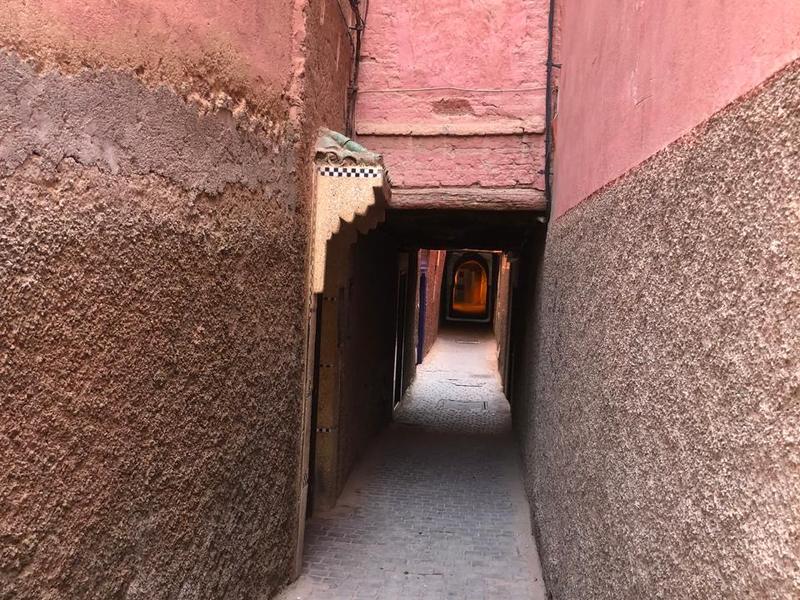
The Mellah occupies the south-eastern corner of the medina, behind the Bahia Palace. Created in the sixteenth century, it once held some forty thousand people and remains one of the best preserved Jewish quarters in Morocco. The lanes are narrower than elsewhere, and the houses have balconies opening onto the street, which you see nowhere else in the city. The Lazama synagogue, built inside a courtyard house, is still in use.
The Jewish cemetery, the Miâara, lies just beside it, hectares of lime-washed tombs. It is a quiet place, often empty, and one of the few spots in Marrakech where the city can be heard from a distance. Adil talks here about how the communities lived alongside each other, a subject he treats with the nuance it deserves rather than with the usual formulas.
The other half of the walk is Sufi. Marrakech is a pilgrimage city, organised around its seven saints, and the zaouias dedicated to them still shape whole quarters. You do not enter the prayer halls, but you come away understanding the brotherhoods, the music, and the place all of this holds in daily life.
Questions about this tour
Can we go inside the synagogue?
Yes, the Lazama synagogue is open to visitors for a small contribution at the door. It is still an active place of worship: dress modestly, and no photographs during a service.
Do you need to be Jewish or Muslim for this to mean anything?
No, and most visitors are neither. The walk is about a city where several communities lived side by side for centuries. It is urban history before it is religion.
Do we go inside the zaouias?
Prayer halls are not open to non-Muslims, as everywhere in Morocco. You see the façades, the doors and the surroundings, and Adil explains what happens inside and why these places matter.