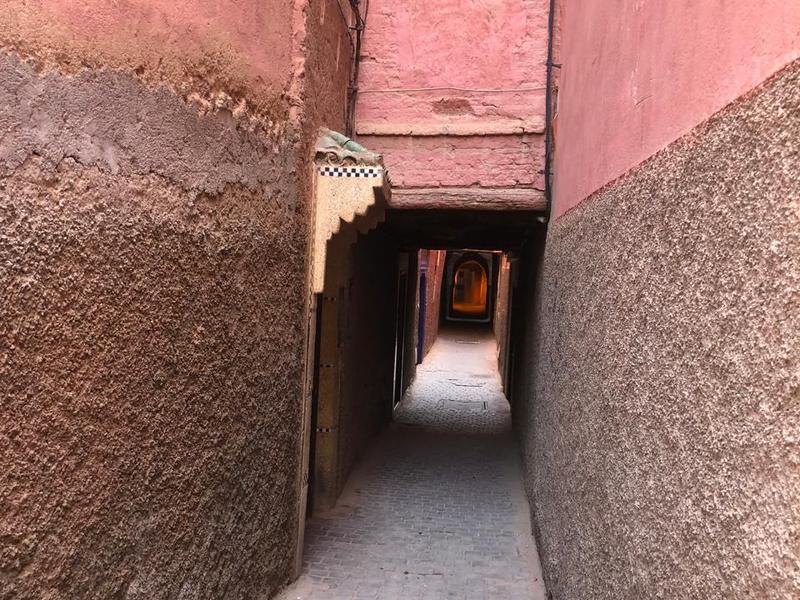
Private walking tour · Marrakech
The Marrakech souks, with a guide.
Where to buy what, at the right price, without the pressure. Adil negotiates with you and arranges door-to-door shipping for anything you cannot carry home.
The itinerary
- Five minutes to say what you are looking for and what you want to spend.
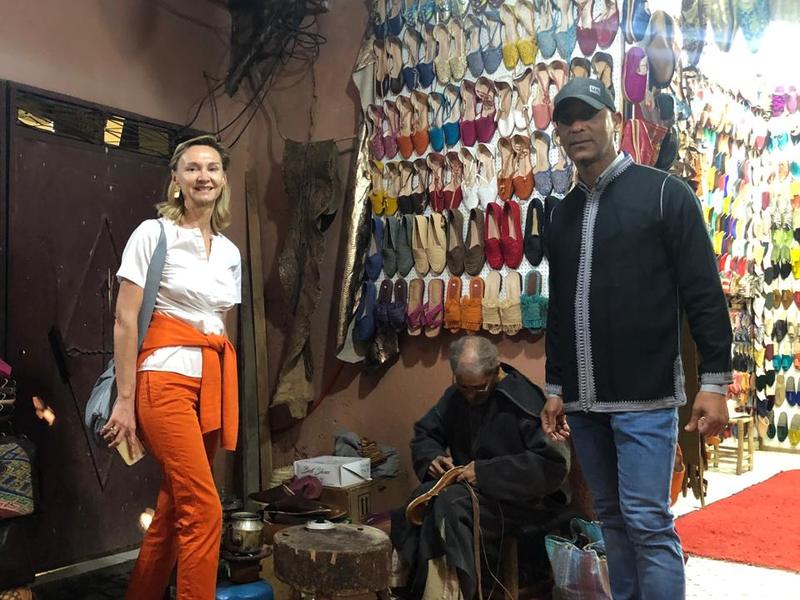
- The workshops: babouches, Berber rugs, metalwork, wood and leather.
- How to tell quality, and what a fair price looks like for each craft.
- Adil negotiates with you, in Arabic, at local rates.
- Door-to-door shipping arranged for anything too big to carry home.
Practical details
This walk is led by Adil, a licensed guide in Marrakech, in English, French or Arabic.
Free cancellation up to 48 hours before the meeting time.
What you actually see
The Marrakech souks are organised by trade, a legacy of the medieval guilds. The dyers’ souk, the ironworkers’, the slipper makers’, the carpet sellers’: each occupies its own lanes, and simply knowing where you are removes half the bad deals. The walk starts with that geography, because it explains why the same object costs three different prices a hundred metres apart.
Adil then takes you to craftsmen who make things on the spot. The difference is visible: a hand-knotted carpet has an irregular back, a hand-sewn slipper has a visible and slightly uneven seam, a hammered tray carries the marks of the tool. He shows you these details before you buy, not after.
Then comes the negotiation, conducted in Arabic, with you taking part. The principle is simple: Adil tells you what the thing is actually worth, and you decide whether you want it at that price. He takes no commission on what you buy, which is precisely why the price comes down. For anything that will not fit in a suitcase, door-to-door shipping is arranged before you leave.
Telling a good piece from a poor one comes down to three or four details you can learn in an afternoon. A hand-knotted rug shows its knots one by one on the back, and its patterns are never perfectly symmetrical. Goat leather tanned in Marrakech keeps a frank smell, the smell of the tanneries, which industrial leather does not have. Hammered copper carries uneven tool marks; cast copper is too smooth. Once you hold those markers you judge for yourself, in any shop, for the rest of the trip.
A few traps come round often enough to be worth naming. The word cooperative is not protected: plenty of shops display it without being one. Saffron sold cheap by weight is almost always cut with safflower, which colours without scenting. Culinary argan oil is brown and smells of toasted nuts; cosmetic argan oil is pale and nearly odourless, and selling one as the other is common. And a price presented as exceptional because it is your last day, or because the shop is closing, is never exceptional.
Then there is the question of what you can sensibly carry home. Rugs and large copper pieces go by freight, and that is arranged on the spot. Safi pottery travels badly in hand luggage and well in a crate. Spices clear customs in most countries, fresh produce does not. And there is what is better not bought at all: pieces presented as antique rarely are, and genuine antique furniture needs export papers that nobody in a souk will hand you.
Questions about this tour
Do we have to buy anything?
No. Plenty of people take this walk to understand the souks and leave with nothing. If you do not buy, the day simply becomes a tour of the workshops, which is interesting in itself.
Does Adil take a commission on our purchases?
No, and that is the heart of the matter. A guide who takes commission has an interest in you paying more. Adil is paid by you, which puts his interest and yours on the same side.
How does shipping abroad work?
By carrier from Marrakech, with tracking. The seller packs, Adil checks the packing and the paperwork. Allow one to three weeks depending on the destination. The cost depends on volume and is quoted to you beforehand.
Can we pay by card in the souks?
Rarely, and it is worth knowing as a bargaining point: many sellers who take cards quietly add the fee to the price. Large rug shops and cooperatives accept them, the small craftsman almost never. Bring cash, drawn from a bank machine rather than changed on the street.
How long should we allow?
Three to four hours, and that is a minimum if you intend to buy a rug. A negotiation done properly takes time: you sit, you drink tea, you look at several pieces. Wanting to be quick is exactly what makes you pay too much.
Is morning or late afternoon better?
Morning, between nine and eleven, the souks are open and still quiet. Late afternoon brings the crowds back, and the light under the covered lanes drops, which makes it hard to judge the colours of a rug or a fabric. Friday midday prayers close part of the stalls.